 English
 中文 (中国)
 Español
July 29, 2026
5 Skills Named After Olympic Gymnasts
October 04, 2026
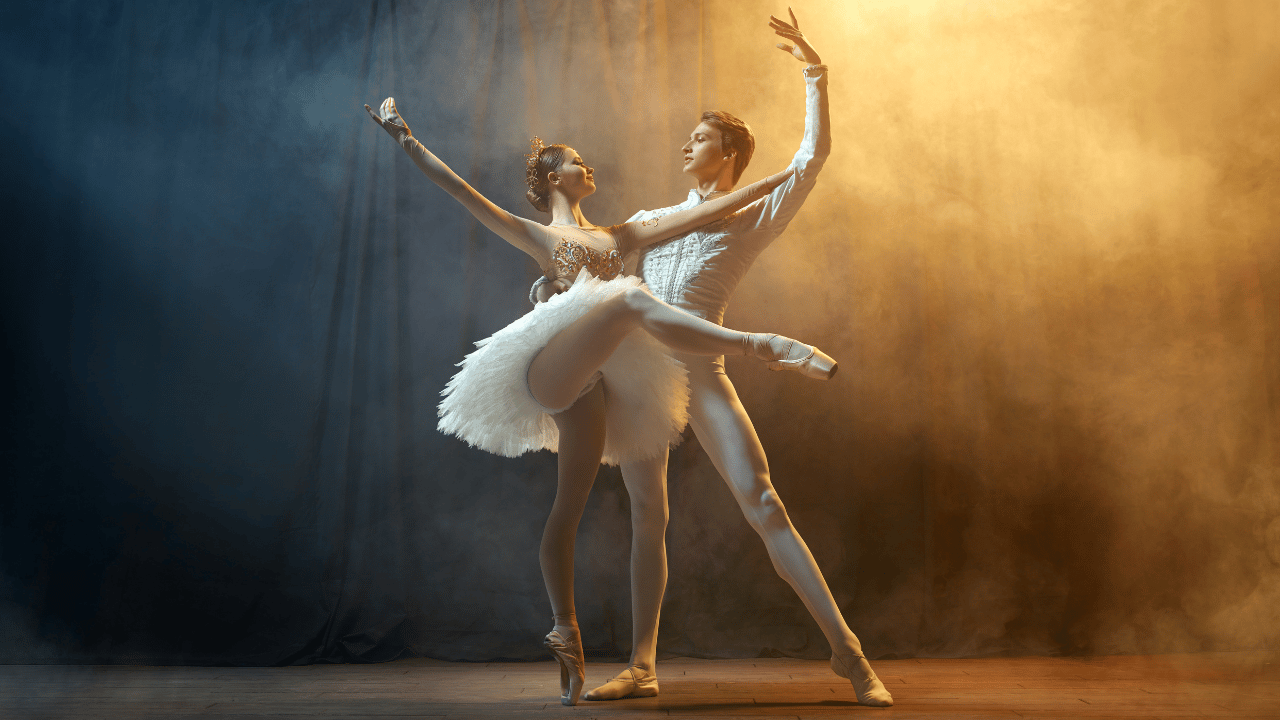
Imagine a silent stage. A woman lifts both hands to her head as if placing an invisible crown, then flutters her arms like wings. Without a single word, the audience understands: she is a queen, and she is a swan. This is the quiet power of dance. Dancers can tell stories, show feelings, and make us cry or laugh using only the body.
How does it work? A dancer has no script, no dialogue, and often no face-to-face chat with the audience, yet thousands of people in a dark theater understand the same story. The answer lies in a mix of old gestures, honest feeling, and tiny details that the body cannot hide. Let’s look at how great dancers and choreographers have done it, from the ballet stage to Indian temples and Spanish tablaos.
In classical ballet, storytelling began with a set of simple gestures that audiences once knew well. A hand placed over the heart meant love, and a finger pointed to the ring finger meant marriage. Two fists crossed in front of the chest could mean death, and a hand moving across the face could mean beauty. Choreographers such as Marius Petipa, who shaped many of the great nineteenth-century ballets, used these signs to move the plot forward between the big dances.
In Swan Lake, the heroine Odette uses this kind of mime to tell the prince that she is a queen turned into a swan by a curse. In Sleeping Beauty, the villain Carabosse stamps and points to announce her revenge, and the whole theater understands it with no words at all. Today, many companies keep these gestures because they are clear, quick, and beautiful when done with real conviction.
Mime is only the start. The deepest moments in ballet come when gesture turns into real emotion. In the famous “mad scene” of Giselle, the young heroine discovers that the man she loves has deceived her. She replays happy memories, grabs for a sword, and slowly loses touch with the world around her. There is no sign language for this moment, only a dancer who lets the feeling travel through her whole body.
Dancers often say that this scene works only when they stop “showing” sadness and start truly feeling it, and the audience can always tell the difference. A raised hand with empty intention looks like a pose. The same hand, held with a clear thought behind it, looks like a person reaching for someone who is no longer there.
Sometimes a single gesture can change the history of dance. In 1912, the Ballets Russes performed L’après-midi d’un faune in Paris, with the great dancer Vaslav Nijinsky in the title role. The choreography was strange for its time, with flat, profile-like poses that looked like figures on an ancient Greek vase. The ending caused the biggest stir, because the faun’s final, private gesture on a scarf left behind by a nymph was seen by some critics as too bold.
The audience argued about it for days, and newspapers took sides. What makes the story useful for us is its lesson: a small movement, placed at exactly the right moment, can say more than a long explanation. Nijinsky showed that a dancer does not need many steps, only a clear idea.
Choreographers have also found new ways to tell old stories. In 1995, the British choreographer Matthew Bourne created a version of Swan Lake in which the swans are played by men. Their movements are strong, wild, and powerful instead of delicate, and many people who had never watched ballet found themselves deeply moved. The production became one of the best-known examples of how changing the body language of a story can change its meaning.
This is a good reminder that gesture is not fixed. The same story, told with a different kind of movement, speaks to a different heart. Dancers and choreographers are always searching for the physical language that fits the feeling.
Modern dance made this idea even bolder. The German choreographer Pina Bausch said she was less interested in how people move than in what moves them. Her piece Café Müller, created in 1978, takes place in a room full of chairs, and Bausch herself danced in it. Dancers walk with closed eyes, and another person rushes to push the chairs out of their way.
There is no plot, yet viewers feel loneliness, care, and longing as clearly as if someone had explained them. Bausch’s work shows that dance does not need a story in the usual sense. It needs a human truth, shown honestly enough that we recognize ourselves in it.
In India, classical dance has treated expression as a science for centuries. In Bharatanatyam, dancers use hand shapes called mudras, along with the face and eyes, to tell old stories. Ancient teaching describes nine basic emotions, called the navarasa: love, humor, compassion, anger, courage, fear, disgust, wonder, and peace. A trained dancer can move through several of them in a few seconds, using only an eyebrow, a glance, and a turn of the wrist.
Kathakali, a dance-drama from the state of Kerala, takes this even further. Performers wear dramatic makeup and costumes, and they do not speak at all. The story is carried by hand gestures, powerful eye movements, and facial expression, which take years of training to master.
Spanish flamenco has its own word for the moment when expression becomes overwhelming: duende. The poet Federico García Lorca gave a famous lecture on the idea in the 1930s, describing it as a dark, deep force that moves both the artist and the audience. A flamenco dancer may stand almost still, with only a raised chin, a slow turn of the wrist, and a stamp of the foot, and the whole room holds its breath.
You do not need to know Spanish or flamenco history to feel it. The dancer’s pride, pain, and joy are all there in the body, and the audience receives them directly. This is one more proof that feeling needs no translation.
Why can we read a dancer’s body so easily? One reason is that we are all experts in body language. From the day we are born, we read faces, shoulders, and hands to know whether someone is safe, tired, angry, or kind. Dance takes this everyday skill and makes it larger, clearer, and more beautiful.
Researchers have also studied how watching dance affects viewers, and many report that audiences feel a kind of physical response in their own bodies when they see strong movement. Whatever the exact science, most of us know the feeling: a dancer leaps, and something in our chest leaps with her.
Dancers use a few simple tools to speak without words, and anyone can learn to notice them. The first is the eyes, because where a dancer looks tells us what she wants, fears, or remembers. The second is breath, which shows how much energy and emotion is inside the movement. The third is weight, since a step placed heavily feels very different from one placed lightly, even if the shape is the same.
The most important tool is intention, which means knowing what the character wants in this exact moment. Many dance teachers ask students a simple question before each movement: “What do you want?” When the answer is clear, even a small gesture becomes full of meaning.
You do not need to be a professional to feel this. Choose one emotion, such as joy or worry, and let it guide a simple walk across the room. Notice how your shoulders, your breath, and your eyes change. Then try the same walk with a different emotion and see how the story changes.
You can also try a small exercise with a friend. Without speaking, tell them a short story, such as “I lost my keys, then I found them,” using only your body. Ask them to guess what happened. You will quickly discover how much you already know about speaking through movement.
Dancing without words is not magic, it is a skill that anyone can grow with practice and curiosity. The next time you watch a performance, forget the steps for a moment and watch the story. Notice the eyes, the breath, and the small choices that make a gesture feel alive. Then try telling a small story of your own, with no words, only movement. You may be surprised by how much you have to say.
Achieve More With VSA: Boost your skills with world-class coaches for just $29/hour. Personalized programs 24/7, 365 days a year, anywhere in the world.
By Vitalina Andrushchenko, Staff Writer
July 29, 2026
5 Skills Named After Olympic Gymnasts
May 24, 2026
How to Improve Toe Point in Ballet
April 28, 2026
5 Ways to Hold Spin Positions Longer
Competition highlights, industry trends, expert opinions, and stories from athletes and artists worldwide — delivered straight to your inbox