 English
 中文 (中国)
 Español
February 19, 2026
The Million-Dollar Medal: Alysa Liu’s Olympic Journey
July 12, 2026
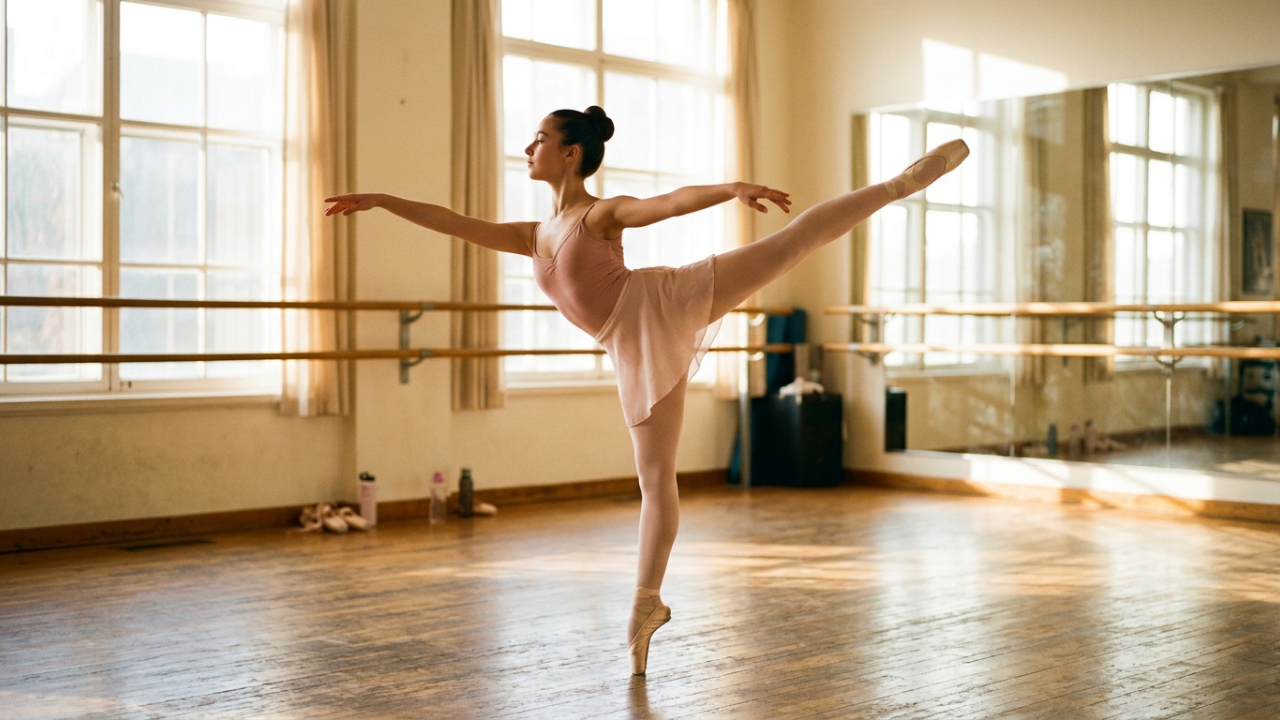
Many dancers believe that a higher arabesque depends only on flexible hips or back. In reality, a beautiful arabesque combines flexibility, strength, balance, posture, turnout, and body control. Even highly flexible dancers can struggle if they lack core stability or proper alignment.
Improving your arabesque takes consistent practice and attention to technique rather than forcing your leg higher.
The standing leg is the foundation of every arabesque.
Practice slow relevés, single-leg balances, and controlled pliés to improve ankle stability and leg strength. Keep your knee lifted, your toes spread naturally on the floor, and your weight centered over the supporting foot.
A stable supporting leg allows the working leg to lift more freely while maintaining balance.
One of the most common mistakes is arching the lower back to create the illusion of a higher leg.
Instead, focus on opening the hip joint while keeping your ribs connected and your pelvis controlled. Gentle hip-flexor stretches, lunges with proper alignment, and glute-strengthening exercises help increase true hip extension.
A slightly lower arabesque with correct alignment always looks cleaner than a higher position achieved by collapsing the back.
A strong upper body allows dancers to maintain a long, elegant line.
Exercises such as Superman holds, Bird Dog, Swan lifts, and forearm planks strengthen the muscles that stabilize the spine. These muscles help keep the chest lifted without excessive tension in the shoulders or lower back.
Aim for quality rather than long repetitions. Controlled movement develops strength more effectively than rushing through exercises.
Stretching alone will not improve your arabesque unless you target the correct areas.
Focus on the hip flexors, quadriceps, hamstrings, calves, and the front of the shoulders. Dynamic stretches before class prepare the body for movement, while longer static stretches after training improve flexibility over time.
Avoid pushing into pain. Gentle, consistent stretching produces better long-term results than aggressive stretching sessions.
Instead of lifting your leg as high as possible every time, practice slow lifts and lowers.
Hold your arabesque for five to ten seconds while maintaining square hips, a long neck, and relaxed shoulders. Use a mirror or record yourself to check whether your supporting leg remains straight and your torso stays aligned.
Practicing slowly develops strength, balance, and body awareness much faster than repeating uncontrolled high kicks.
Many dancers make the same technical errors:
Turning the hips outward instead of keeping proper alignment, locking the standing knee, lifting the shoulders toward the ears, collapsing the lower back, pointing the foot without fully lengthening the leg, and holding the breath during the position.
Correcting these small habits often produces noticeable improvement within a few weeks.
A simple daily routine can improve your arabesque:
Five minutes of dynamic hip mobility, three sets of single-leg balances, two sets of Bird Dog exercises, two sets of Superman holds, ten slow arabesque lifts on each leg, followed by gentle hip-flexor and quadriceps stretches.
This entire routine takes about fifteen minutes and can easily be added after ballet class or home practice.
Motion analysis studies show that elite ballet dancers generate arabesque height through coordinated movement of the hip, pelvis, spine, and supporting leg—not by flexibility alone. Professional ballet training therefore emphasizes strength, alignment, and movement efficiency alongside flexibility development.
(Source: Dance medicine and sports science research)
A beautiful arabesque is created through balance, strength, mobility, and control working together.
By strengthening your supporting leg, improving hip extension, building core stability, stretching intelligently, and practicing with excellent technique, you will develop an arabesque that is not only higher but also stronger, safer, and more elegant.
Achieve More With VSA: Boost your skills with world-class coaches for just $29/hour. Personalized programs 24/7, 365 days a year, anywhere in the world.
By Vitalina Andrushchenko, Staff Writer
February 19, 2026
The Million-Dollar Medal: Alysa Liu’s Olympic Journey
February 21, 2026
A Guide to Rhythmic Gymnastics Apparatus
February 18, 2026
Ami Nakai Stuns With Triple Axel to Lead Olympic Short Program
Competition highlights, industry trends, expert opinions, and stories from athletes and artists worldwide — delivered straight to your inbox