 English
 中文 (中国)
 Español
July 29, 2026
5 Skills Named After Olympic Gymnasts
August 22, 2026
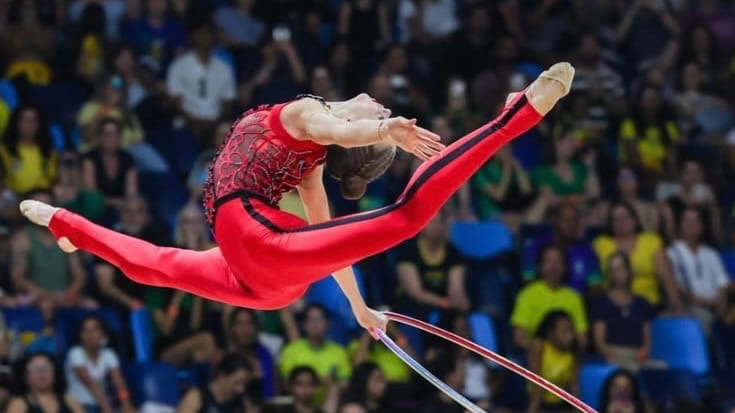
Taisiia Onofriichuk © Pinterest
Frankfurt delivered a spectacular celebration of rhythmic gymnastics as the 2026 World Championships brought together the sport’s leading athletes and groups from around the world.
Held from 12–16 August, the 42nd Rhythmic Gymnastics World Championships featured 73 nations, 99 individual gymnasts and 42 groups. Across five days of competition, Frankfurt showcased the growing level, creativity and global reach of the sport.
The biggest individual headline belonged to Germany’s Darja Varfolomeev.
The reigning Olympic champion captured her third consecutive world all-around title, achieving the feat in front of her home crowd. The victory was particularly meaningful because Varfolomeev had dreamed of winning gold and hearing the German national anthem in her own country.
Yet the competition was far from easy.
After the all-around final, Varfolomeev described it as one of the toughest competitions of her career, explaining that winning does not necessarily become easier with experience. Instead, the pressure can grow with every title.
Her performance was nevertheless remarkable. Varfolomeev recorded the highest score of the entire championships, earning 31.500 for clubs during the all-around final. Across the competition, she collected six scores above 30 points.
Brazilian rhythmic gymnastics also produced one of Frankfurt’s most memorable stories.
The Brazilian group won the country’s first-ever world gold medal in the 5 Balls final.
But the achievement did not stop there.
The group followed its historic victory with another gold in the 3 Hoops + 2 Clubs final, immediately proving that the first triumph was no accident.
Two world titles transformed Brazil into one of the standout stories of the championships.
Bulgaria’s Stiliana Nikolova had already collected multiple medals during her four World Championships appearances, but one achievement had remained out of reach: an individual world title.
Frankfurt finally changed that.
Nikolova won the clubs gold medal with 30.150, securing the first world championship title of her career.
The emotional significance of the moment was clear. After discovering that she had become world champion, Nikolova said she cried.
Her breakthrough was one of the defining individual moments of the championships.
Ukraine also celebrated a major milestone through Taisiia Onofriichuk.
The Ukrainian gymnast won the country’s first individual world gold since Anna Rizatdinova’s hoop victory in 2013.
Onofriichuk also won her title in the hoop final, producing a score of 30.700, the second-highest score recorded at the championships.
Her victory marked an important return to the top of the individual world stage for Ukraine.
Perhaps the most revealing statistic from Frankfurt was the number of gymnasts breaking the 30-point barrier.
At least eight athletes achieved scores of 30 or higher during the championships: Varfolomeev, Onofriichuk, Nikolova, Sofia Raffaeli, Daniela Munits, Takhmina Ikromova, Akmaral Yerekesheva and Mariia Borisova.
The hoop final provided an especially striking example of the rising standard: the top five gymnasts all scored at least 30 points.
The results suggest that the technical and artistic level of rhythmic gymnastics continues to rise across different countries and continents.
Germany finished at the top of the medal table with three gold medals and one bronze, all won by Varfolomeev.
Bulgaria, meanwhile, collected the most medals overall, with six. Nikolova contributed three, Bulgaria’s group won two bronze medals, and the Bulgarian team added a silver.
The medals were spread across the world. Nine nations from three continents reached the podium in Frankfurt, including Germany, Bulgaria, the Russian Federation, Spain, Ukraine, Italy, China, Japan and Brazil.
Frankfurt also marked an important step toward the Los Angeles 2028 Olympic Games.
The championships awarded the first Olympic quota places to the top three individual gymnasts and top three groups.
Germany, Bulgaria and Italy earned the individual quotas, while Spain, Japan and Brazil secured the group quotas for their nations.
These places represent the beginning of the road toward LA28, although the final selection of athletes remains the responsibility of each National Olympic Committee.
The 2026 World Championships demonstrated just how international rhythmic gymnastics has become.
From Varfolomeev’s historic home victory and Nikolova’s emotional breakthrough to Brazil’s double group triumph and Onofriichuk’s return to Ukrainian individual gold, Frankfurt produced stories across multiple generations and nations.
The combination of skill, creativity, diversity and passion offered a strong indication of where the sport is heading.
The next World Championships will take place in Baku, Azerbaijan, from 15–19 September 2027.
Source: article on gymnastics.sport published August 17, 2026.
Achieve More With VSA: Boost your skills with world-class coaches for just $29/hour. Personalized programs 24/7, 365 days a year, anywhere in the world.
By Vitalina Andrushchenko, Staff Writer
July 29, 2026
5 Skills Named After Olympic Gymnasts
March 17, 2026
Hall of Fame: ISU Figure Skating Awards Winners
March 05, 2026
Nakata Sets Record in Tallinn
Competition highlights, industry trends, expert opinions, and stories from athletes and artists worldwide — delivered straight to your inbox