 English
 中文 (中国)
 Español
February 19, 2026
The Million-Dollar Medal: Alysa Liu’s Olympic Journey
July 22, 2026
For decades, artistic gymnastics judges had only one chance to evaluate every routine. A vault lasting just a few seconds or a release move on the uneven bars could determine medals, and every deduction had to be made in real time. As routines became faster and more technically complex, relying only on what judges could see with the naked eye became increasingly difficult.
Today, video replay has become an important part of artistic gymnastics judging. Although the final score is still based on the judges’ expertise and the Code of Points, video technology helps improve accuracy, consistency, and fairness during major international competitions.
(Source: Fédération Internationale de Gymnastique (FIG), FIG Technical Regulations)
Modern gymnastics contains elements that happen incredibly quickly. Double and triple twisting vaults, release skills on uneven bars, multiple salto combinations on floor exercise, and complex dismounts often occur in less than a second.
Without replay, judges sometimes had difficulty confirming whether:
an athlete completed enough twists, a hand touched the apparatus, legs separated during a skill, a landing stayed within the boundary line, or a gymnast performed an element exactly as declared.
Video replay allows judges to review these moments before confirming the final score.
Contrary to what many fans believe, judges do not constantly stop routines to watch videos.
Replay is primarily used during high-level FIG competitions when there is uncertainty about a technical element or when a superior jury reviews a score.
Different camera angles help officials examine:
body position during flight, completion of twists and rotations, hand placement on apparatus, landing control, boundary line violations, execution of difficult connections.
The goal is not to replace judges but to support their decisions with additional visual evidence.
The introduction of replay has encouraged athletes to perform skills with cleaner technique rather than relying on movements that may appear correct from only one viewing angle.
Small technical errors that once might have gone unnoticed can now be identified much more consistently.
As a result, coaches increasingly focus on:
straight knees and pointed toes, fully extended body positions, precise hand placement, controlled landings, cleaner connections between elements.
Modern elite gymnastics rewards precision more than ever before.
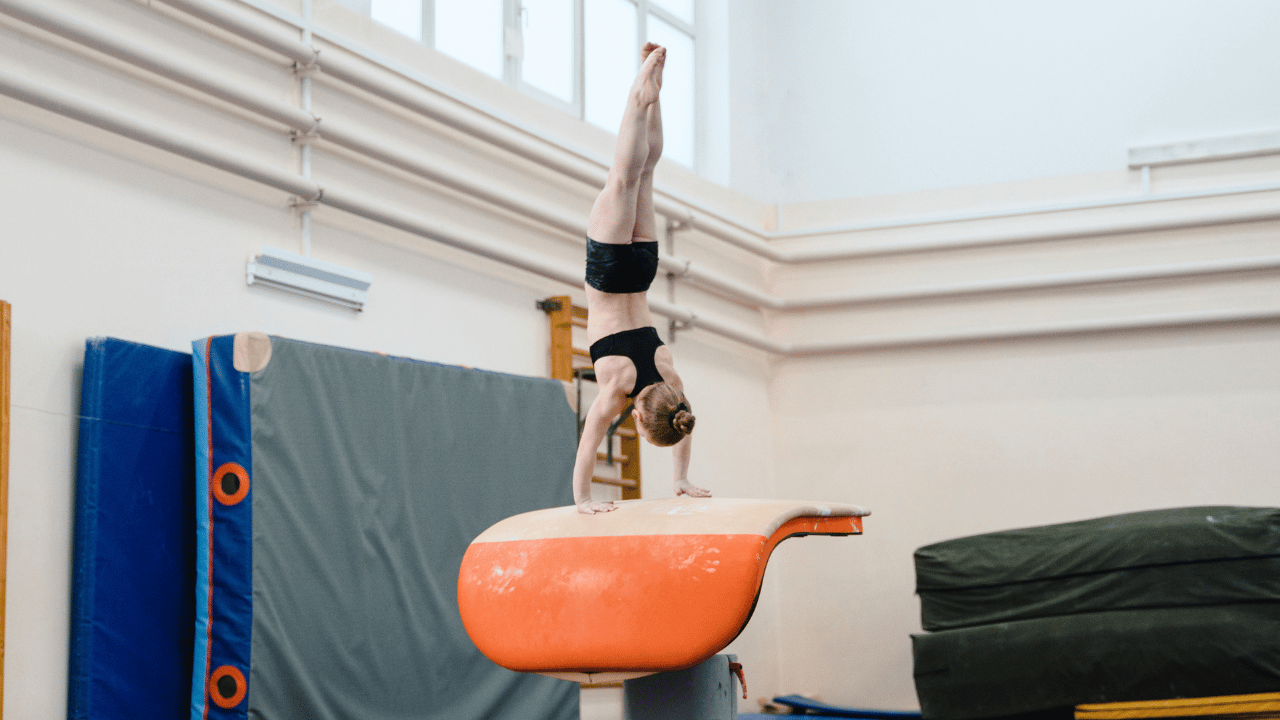
Vault is one event where replay has had a particularly significant impact.
Olympic champion Simone Biles performs some of the most difficult vaults ever attempted. Her Yurchenko double pike contains so much height and rotation that judges must accurately determine whether every phase of the skill meets the requirements of the Code of Points.
Video replay helps officials confirm body position during flight, landing control, and whether the skill is fully completed before contact with the mat.
Because vault happens in only a few seconds, replay provides valuable support for judging some of the sport’s most complex elements.
Uneven bars also benefit greatly from replay technology.
Release moves such as the Nabieva, Def, or connections involving multiple flight elements happen extremely quickly.
Replay allows judges to verify whether catches were secure, body positions met technical requirements, and connections were completed without interruption.
This produces more consistent scoring across different competitions.
The FIG introduced official video review systems to support judging at major international competitions as routines became increasingly difficult. Modern World Championships and Olympic Games use multiple synchronized camera angles that allow superior juries to review technical situations before scores become official. Video replay supports both Difficulty and Execution judging but does not automatically determine scores. Human judges continue to make the final decisions according to the FIG Code of Points.
(Source: FIG Technical Regulations, FIG Code of Points)
Do not train only for what looks impressive from the audience.
Practice every skill with correct body alignment, complete every twist before landing, control your posture during flight, finish each element with precision, and review videos of your own routines regularly. Watching slow-motion recordings can reveal details that are impossible to notice during normal-speed practice.
Video replay has made artistic gymnastics judging more accurate without replacing the experience of human judges.
As gymnastics continues to evolve, technology helps ensure that medals are decided by the quality of performance rather than by missed details. For athletes, this means that excellent fundamentals, clean execution, and precise technique are more valuable than ever.
Achieve More With VSA: Boost your skills with world-class coaches for just $29/hour. Personalized programs 24/7, 365 days a year, anywhere in the world.
By Vitalina Andrushchenko, Staff Writer
February 19, 2026
The Million-Dollar Medal: Alysa Liu’s Olympic Journey
February 21, 2026
A Guide to Rhythmic Gymnastics Apparatus
February 18, 2026
Ami Nakai Stuns With Triple Axel to Lead Olympic Short Program
Competition highlights, industry trends, expert opinions, and stories from athletes and artists worldwide — delivered straight to your inbox